

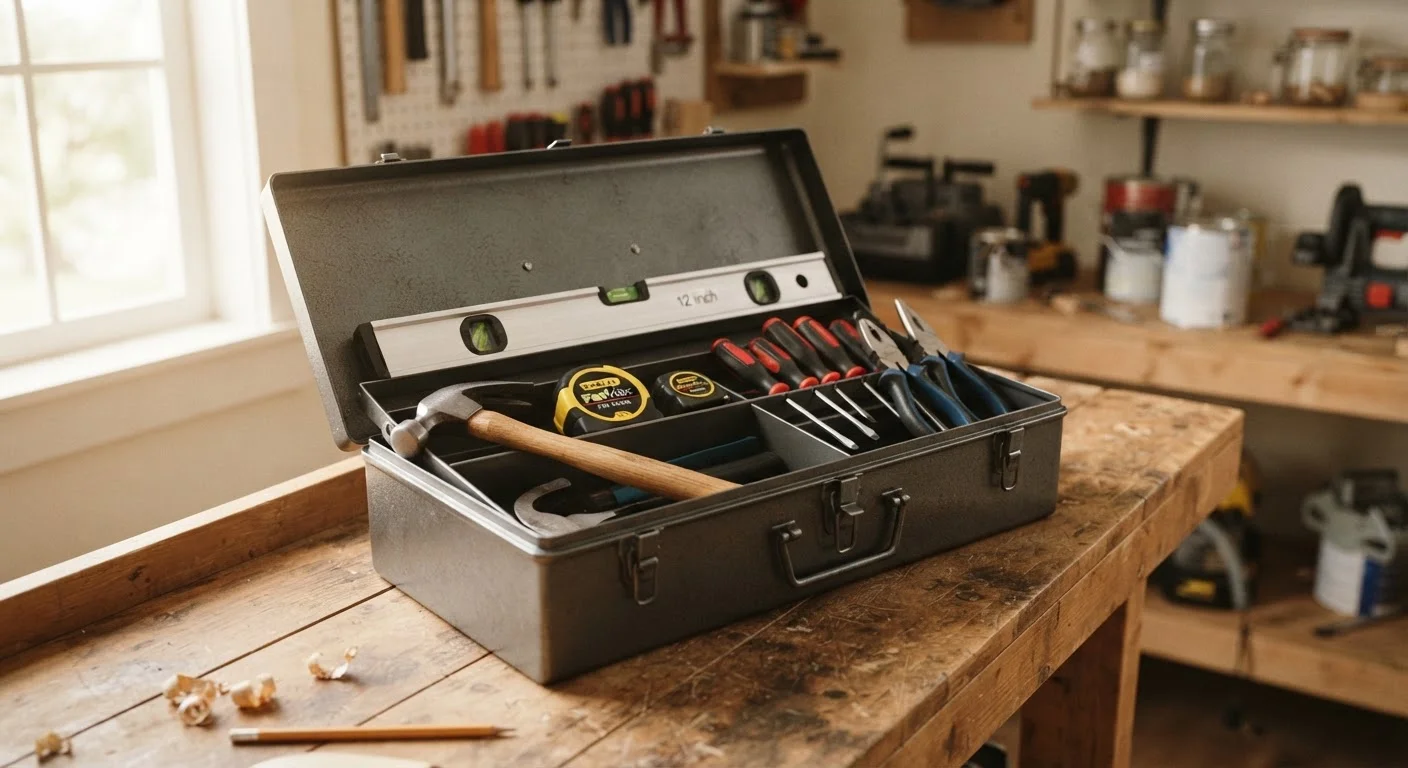
Why Every Household Needs a Starter Toolkit
Loose cabinet hinges, a picture that needs hanging, a squeaky door - these are the kinds of small repairs that come up in every home. Without the right tools on hand, families are forced to either ignore the problem or call someone in. Neither is ideal. A modest starter toolkit changes that equation entirely.
You don't need a workshop full of power tools to handle the most common household fixes. A focused set of quality hand tools covers the majority of repairs families actually face day to day. Before you grab your first tool, though, it helps to understand exactly what's worth having - and why. See our overview of DIY-friendly repairs to know which jobs are genuinely safe to tackle yourself.
| Toolkit category | Hand tools, measuring gear, safety equipment |
| Recommended tape measure length | 25 feet |
| Hammer weight for general use | 16 oz |
| Minimum screwdriver types needed | Flathead and Phillips, multiple sizes each |
| Dust mask standard for sanding | N95-rated (U.S. NIOSH respirator rating) |
| Level size for shelving and fixtures | 24 inches |
The Core Hand Tools Every Kit Needs
Start here. These tools handle the widest range of everyday repair tasks and form the foundation of any household kit.
- Claw hammer: The all-purpose go-to for driving nails, hanging artwork, and light demolition like removing baseboards. A 16-oz head is the most versatile weight for general use.
- Flathead and Phillips screwdrivers (multiple sizes): Screws are everywhere in a home - furniture, outlet covers, hinges, appliances. Having at least two sizes of each type means you're ready for most situations.
- Adjustable wrench: Tightens and loosens nuts and bolts without needing a full socket set. Useful for plumbing fixtures and furniture assembly.
- Needle-nose pliers: Grip small hardware, bend wire, and reach into tight spots where fingers won't fit.
- Utility knife: Scores drywall, opens packaging, and trims caulk or weatherstripping cleanly.
- Putty knife: Spreads spackling compound for small wall holes and removes old caulk or paint buildup.
These six tools alone can address dozens of common household repairs. If you're just getting started, our guide on tackling repairs as a complete beginner walks through how to approach each job with confidence.
Measuring and Layout Tools
Accurate measurements prevent wasted materials, crooked shelves, and furniture that doesn't fit through doorways. These tools keep your work precise.
Plumb
Perfectly vertical, as determined by a level or plumb bob. A wall or post that is plumb stands straight up and down without leaning.
Level
Perfectly horizontal, with no tilt side to side. A shelf that is level won't cause items to slide off in either direction.
Spackling compound
A lightweight paste used to fill small holes, dents, or cracks in drywall or plaster walls before painting. It dries hard and can be sanded smooth.
Caulk
A flexible sealant applied along joints or gaps - such as around a bathtub or window frame - to prevent air, water, or pests from passing through.
Pilot hole
A small hole drilled before driving a screw or bolt to prevent the surrounding material from splitting and to guide the fastener accurately.
- Tape measure (25 ft): The workhorse of any toolkit. A 25-foot length handles room dimensions, furniture placement, and framing tasks alike. Look for a blade with clear, large markings.
- Carpenter's level (24 in): Ensures shelves, frames, and fixtures are truly level or plumb - not just visually close. A bubble level this size is reliable and easy to read.
- Speed square: A triangular guide that confirms 90-degree corners and helps mark consistent cut lines on lumber.
- Pencil and chalk line: Marking tools that make accurate layout possible before drilling or cutting.
Measurement errors are one of the most common reasons DIY repairs go sideways - see common DIY missteps and how to avoid them for real-world examples.
Safety Gear and Smart Storage
No toolkit is complete without protective equipment. Safety gear is non-negotiable, especially when children are in the home.
- Safety glasses: Protect eyes from debris when hammering, drilling, or cutting. Keep a spare pair - anyone helping on a project needs their own.
- Work gloves: Guard against splinters, sharp edges, and abrasions during heavier tasks.
- Dust mask (N95-rated): Necessary when sanding drywall or working in dusty spaces.
- Flashlight or headlamp: Many repair spots - under sinks, inside closets, behind appliances - are poorly lit. A headlamp keeps hands free.
Store your toolkit in a dedicated case or toolbox, locked or placed out of reach of young children. Good storage protects the tools and makes them faster to find when a repair comes up. If you apply the same organizing mindset to the rest of your home, the Home Organization hub offers practical strategies room by room.
Building your first toolkit is an investment in confidence as much as hardware. Start with these essentials, keep them in good condition, and you'll be ready for the repairs that come with owning or renting a home.
The content provided on our blog site traverses numerous categories, offering readers valuable and practical information. Readers can use the editorial team’s research and data to gain more insights into their topics of interest. However, they are requested not to treat the articles as conclusive. The website team cannot be held responsible for differences in data or inaccuracies found across other platforms. Please also note that the site might also miss out on various schemes and offers available that the readers may find more beneficial than the ones we cover.