

Where the Envelope Method Comes From
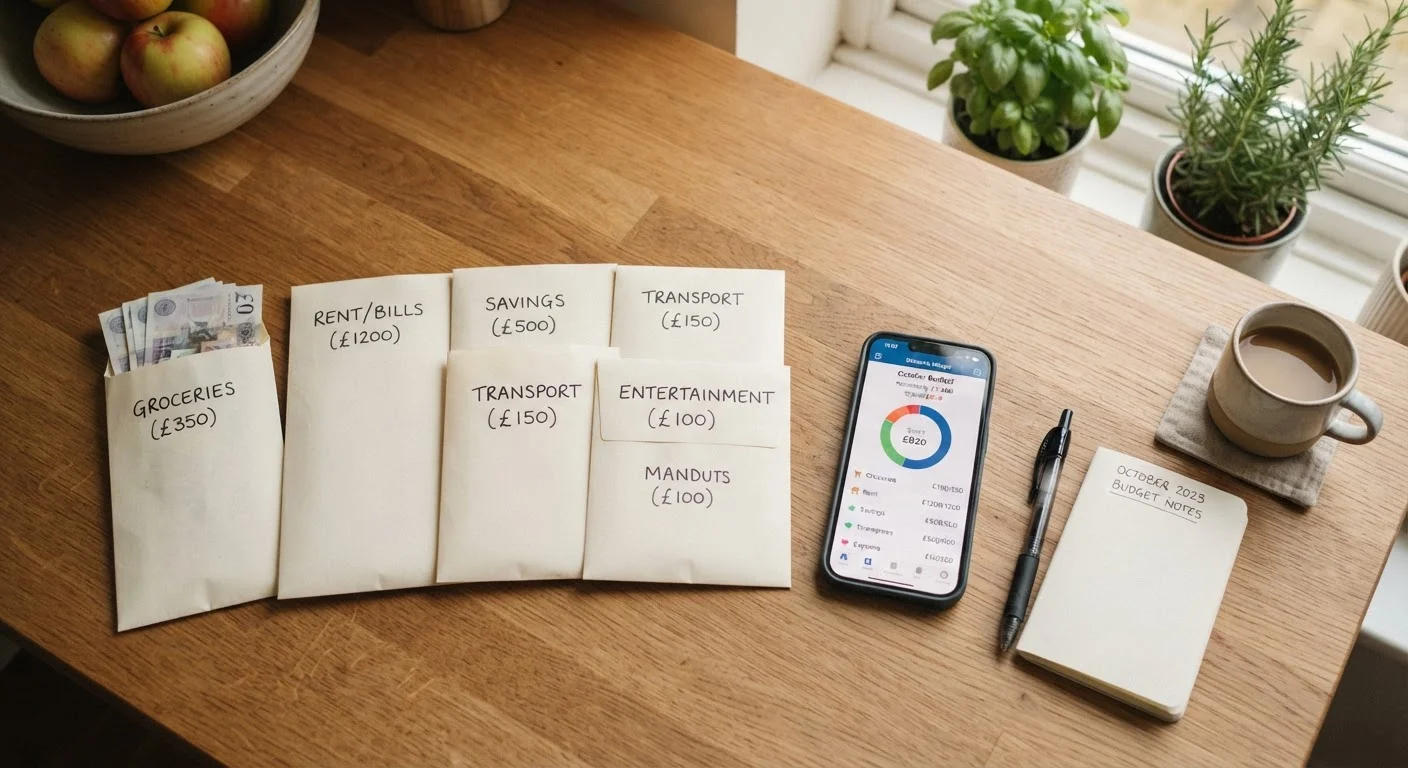
Envelope budgeting has been around for generations - long before personal finance apps existed. The idea is straightforward: on payday, you divide your cash into envelopes, one per spending category. When the grocery envelope hits zero, you're done buying groceries until next month. No negotiating, no rounding up.
The method became widely associated with cash-based households who needed a tactile, visual way to enforce limits. It works because it converts an abstract budget line into something you can physically hold - and physically empty.
If you're new to budgeting in general, Family Budgeting From Scratch is a good place to build context before applying any specific method.
The Core Logic That Hasn't Changed
Strip away the envelopes themselves and the principle is this: spending in each category is capped in advance, not reviewed after the fact. Most budgeting failures happen because families track spending retrospectively - they look at what they spent last month and feel bad about it, but no limit was in place to stop it from happening.
Envelope budgeting flips that sequence. The limit exists before you spend, not after. That single shift is responsible for most of the method's effectiveness.
1 in 3
U.S. adults with no written budget
Surveys by the National Foundation for Credit Counseling have consistently found that a large share of adults track spending informally or not at all, leaving no category limits in place before spending happens.
$500+
Monthly overspend on food for average family
USDA food cost data suggests many families spend significantly more on food (groceries plus dining out combined) than they estimate, partly because no per-category cap was set in advance.
3-6 months
Typical time to build the habit
Financial educators commonly note that envelope-style budgeting takes a few months of adjustment before category allocations align with real spending patterns - initial allocations rarely stick perfectly.
This pre-commitment structure is what separates envelope budgeting from general expense tracking. You can learn the difference between these approaches - and others like the 50/30/20 rule - in our comparison of zero-based budgeting vs. the 50/30/20 rule.
Applying the Method Without Physical Cash
For most families today, cash transactions are the exception. Groceries go on a debit card; utilities are autopaid; kids' activities are billed online. That doesn't make envelope logic obsolete - it just requires a different container.
Three practical approaches work well for digital households:
- Separate checking accounts or sub-accounts: Some banks and credit unions allow you to open multiple free checking accounts. Label one "Groceries," one "Gas," one "Dining." Transfer each category's monthly allocation in on payday. When the account is empty, the category is closed.
- Budgeting apps with virtual envelopes: Several widely used apps apply envelope logic digitally, letting you assign income to virtual categories and track real-time balances. The app acts as the envelope; your debit or credit card is just the spending mechanism.
- Spreadsheet tracking with a pre-set limit column: If you prefer to keep things manual, a simple spreadsheet with category columns and a running balance does the same job. It requires more discipline - nothing stops you from spending - but the visual running total creates a similar friction to a thinning envelope.
The tool matters less than the habit. What you're really building is the practice of checking your category balance before spending, not after.
Setting Up Categories That Reflect Real Family Life
Generic budget templates often list categories that don't match how a family actually spends money. "Entertainment" doesn't capture the reality of youth sports fees, streaming subscriptions, birthday party supplies, and the occasional family dinner out all competing for the same dollars.
A realistic starting-point category list for a household with children might look like this:
- Housing (mortgage or rent, utilities, insurance)
- Groceries
- Transportation (gas, insurance, maintenance fund)
- Kids' activities and school expenses
- Dining out and takeout
- Clothing
- Medical and pharmacy
- Debt payments
- Savings and emergency fund
- Everything else (a small miscellaneous buffer)
Notice that savings and debt payments are treated as envelopes - not leftovers. This is the move that makes the method functional for families working toward financial goals, not just tracking where money went. For a deeper look at term definitions as you build your system, the Family Finance Glossary is a useful reference.
Start With Just Three Envelopes
If the full category list feels overwhelming, begin with only your three highest-spending variable categories - typically groceries, dining out, and miscellaneous. Get comfortable checking balances before spending for one month, then add more categories. A small system you actually use beats a complete system you abandon in week two.
Common Sticking Points and How to Handle Them
The most common frustration families report is the irregular expense: the car registration, the annual insurance premium, the back-to-school shopping surge. These feel like budget-busters, but they're predictable if you plan a month ahead.
The fix is a sinking fund envelope - a category where you save a small amount each month for an expense you know is coming. If car registration costs $240 annually, $20 goes into that envelope every month. When the bill arrives, the money is already set aside.
The second sticking point is envelope raiding - borrowing from groceries to cover dining out, or pulling from clothing to handle an unexpected expense. A small buffer envelope labeled "miscellaneous" or "buffer" can absorb genuine surprises without forcing you to cannibalize important categories. If you find yourself raiding frequently, it's usually a signal that one of your category allocations is set too low relative to actual spending, not that the method doesn't work.
For a broader framework that puts envelope budgeting in context alongside savings strategies and other tools, the Complete Household Budgeting Guide covers the full picture.
This article is for general informational and educational purposes only. It is not personalized financial advice. Consider speaking with a qualified financial professional about decisions specific to your household's situation.
Frequently Asked Questions
No. Physical cash helps some people feel spending limits more concretely, but the underlying principle - capping spending by category - works equally well with digital tools, sub-accounts, or spreadsheets. The cash is a vehicle, not the method itself.
Most financial educators suggest starting with 6-10 categories covering your real spending patterns. Too few categories lose detail; too many become impossible to track. Start broad and split a category later if you need more control in a specific area.
You have two options: stop spending in that category until the month resets, or consciously move money from a lower-priority envelope to cover the shortfall. Either choice is intentional, which is exactly the point of the method.
It can work, but requires an adjustment. Many families with variable income budget off their lowest expected monthly income rather than an average, then treat any extra as a bonus assigned to savings or debt. This prevents overcommitting envelopes in leaner months.
Yes. By treating debt payments as a dedicated envelope with a firm monthly amount, you protect that payment from being crowded out by other spending. See our guidance on <a href="/family-finance/saving-and-debt/building-your-first-family-budget-around-debt-and-savings">budgeting around debt and savings</a> for how to build this in from the start.
Envelope budgeting is effectively a subset of zero-based budgeting. Both require assigning every dollar a job before the month begins. The difference is that envelope budgeting emphasizes a physical or virtual container per category, making limits more tangible and harder to ignore.
The content provided on our blog site traverses numerous categories, offering readers valuable and practical information. Readers can use the editorial team’s research and data to gain more insights into their topics of interest. However, they are requested not to treat the articles as conclusive. The website team cannot be held responsible for differences in data or inaccuracies found across other platforms. Please also note that the site might also miss out on various schemes and offers available that the readers may find more beneficial than the ones we cover.